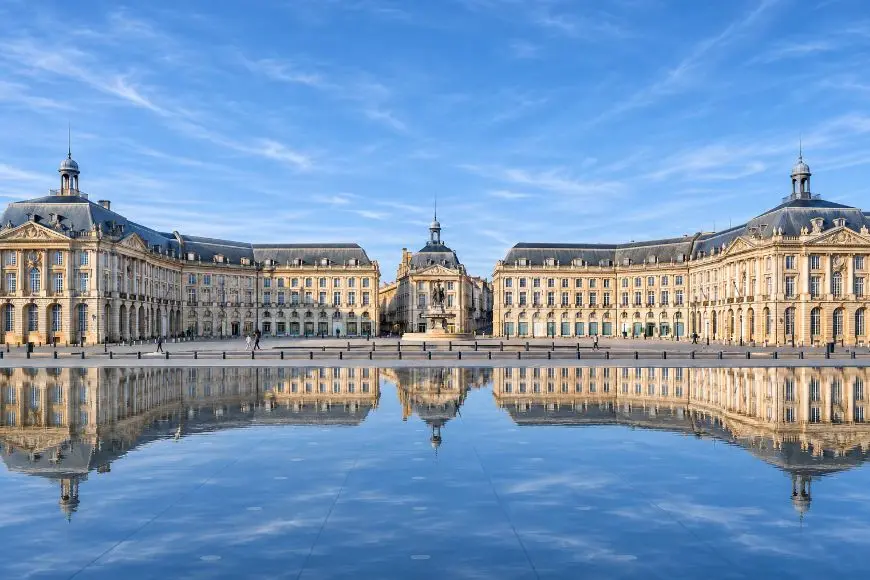
How to visit Place de la Bourse in Bordeaux

Place de la Bourse is one of the must-see sights of any stay in Bordeaux. Three centuries of urban history can be read in its façades and in the way it opens onto the Garonne river. In this guide, we help you understand the architecture, spot the details worth a closer look, find a terrace for lunch, park nearby and take great photos. Follow our tips to visit the square like a local.
Discover everything Zoologie offers for your stay in Bordeaux.
| Key facts: – Place de la Bourse was the first open square in French town planning, designed by the architects Jacques and Ange-Jacques Gabriel in the 18th century – Its name changed with each regime: Place Royale, Place de la Liberté, Place Impériale, Place Royale again, and finally Place de la Bourse in 1848 – The Water Mirror (Miroir d’eau) opposite the square is often described as the largest reflecting pool in the world (3,450 m²); it runs in the warmer months, from 10am to 10pm – The closest car park, Bourse – Jean-Jaurès, is a 2-minute walk away; Camille Jullian and Tourny are less than 10 minutes away – The National Customs Museum is housed in the former Hôtel des Fermes, on the south side of the square (entrance at 1 place de la Bourse) |
The history and architecture of Place de la Bourse
Every part of the façade reflects the ambition of an 18th-century city that wanted to open up to its river.
From Place Royale to Place de la Bourse: three centuries of history
In the late 1720s, the intendant Claude Boucher asked the royal architect Jacques Gabriel to design a square that would open Bordeaux onto the Garonne [1]. The project broke with the enclosed squares of the Middle Ages: it was the first open square in France, with no gates or barriers, designed like a stage facing the river. Work began in 1730. Jacques Gabriel led the project until his death in 1742, and his son Ange-Jacques Gabriel then took over. The equestrian statue of Louis XV was unveiled on 19 August 1743, but the whole ensemble was only completed in 1755 [3].
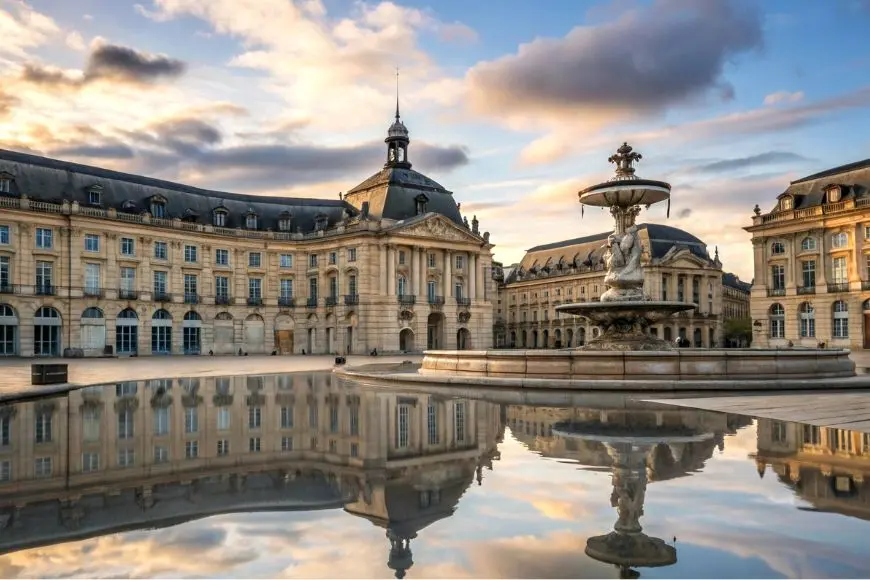
The square changed its name with each political regime. Under the Ancien Régime it was called Place Royale, with an equestrian statue of Louis XV at its centre. The Revolution renamed it Place de la Liberté: the statue was destroyed in 1792 and its bronze melted down to make cannons. Napoleon turned it into Place Impériale, the Restoration gave it back the name Place Royale, and it was only in 1848 that it took its current name, Place de la Bourse, after the Palais de la Bourse (stock exchange) on its north side. Since 1869, the Fountain of the Three Graces, designed by Louis Visconti, has stood where the statue once was [2].
The Palais de la Bourse and the Hôtel des Douanes, Gabriel’s masterpieces
Two large buildings frame the square on either side of a central pavilion and give it its classical setting. To the north, the Palais de la Bourse is now home to the Bordeaux Chamber of Commerce and Industry. To the south, the former Hôtel des Fermes du Roy, built for the royal tax farmers, still houses the customs services, which is why it is also known as the Hôtel des Douanes (Customs House). Their sculpted pediments, facing both the square and the quay, celebrate Bordeaux’s maritime and commercial wealth.
The ensemble is a listed historic monument and part of “Bordeaux, Port of the Moon”, a UNESCO World Heritage Site since 2007. Its style follows the codes of French royal architecture: tall ground-floor arcades, ordered façades, pilasters and slate mansard roofs. The central pavilion is the focal point of the composition, visible from the quays and from the right bank.
The National Customs Museum, a cultural stop on the square
The former Hôtel des Fermes, on the south side of the square, houses the National Customs Museum (Musée national des douanes), with its entrance at 1 place de la Bourse. It is the only museum in France dedicated to the history of customs, and it reopened in May 2025 after a renovation with a more interactive layout. It traces the history of the customs administration from Antiquity to the present day through seized objects, uniforms, measuring instruments and works of art.
The museum is open Tuesday to Sunday, 10am to 6pm, and closed on Mondays, 1 January and 25 December. Admission is charged, with free entry for some visitors: check current prices on the museum’s website before you go. Allow about an hour for your visit, which fits easily into a weekend in Bordeaux.
Top things to see around Place de la Bourse
Once you understand the architecture, it is time to discover what makes the square famous: the Water Mirror, the sculpted details of the façades and the events that bring the riverside to life throughout the year.
The Water Mirror, the world’s largest reflecting pool, opposite the square
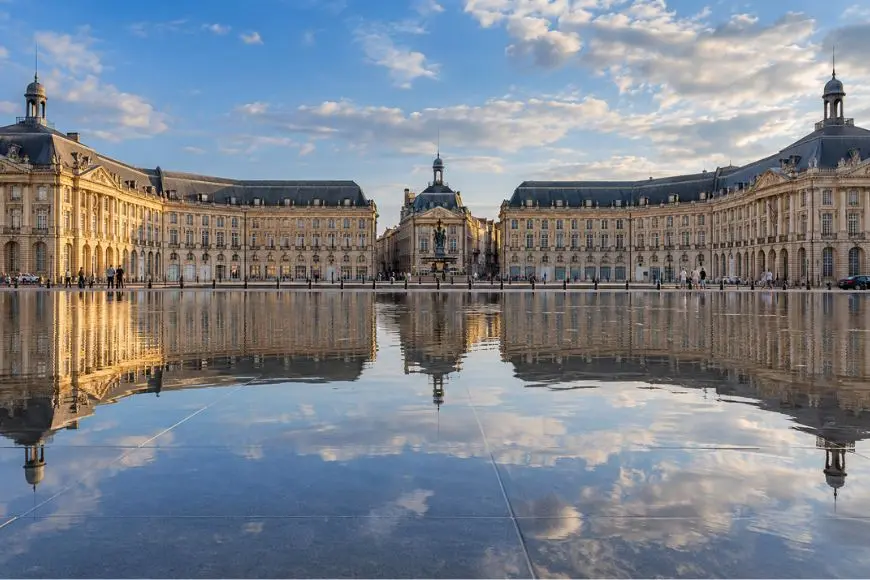
Opened in 2006, the Bordeaux Water Mirror covers 3,450 m² of the quays, right opposite the façade of Place de la Bourse [4]. Designed by landscape architect Michel Corajoud and built with fountain designer Jean-Max Llorca and architect Pierre Gangnet, this granite slab covered with 2 cm of water alternates between a mirror, a mist and a thin sheet of water. The listed façade is reflected as if on a lake, making it one of the most photographed spots in Bordeaux.
The Water Mirror runs in cycles of about 23 minutes, from 10am to 10pm, during the warmer months: it is usually switched on in spring and turned off in autumn to protect it from frost. The mist phases are a favourite with photographers and offer a welcome way to cool down on hot days. To find out more, see our page dedicated to the Bordeaux Water Mirror.
The listed façades and the architectural details to look out for
Look up as you walk onto the square: the sculpted pediments of both buildings feature mythological figures such as Neptune, Minerva and Mercury, celebrating the sea, the arts and trade. In the middle of the square, the Fountain of the Three Graces depicts Aglaea, Euphrosyne and Thalia, the daughters of Zeus.
The façades are decorated with sculptures worth a closer look: above each arch, a mascaron (a carved stone face) recalls the city’s maritime and commercial history. The view over the Garonne was designed like an open-air stage: the square has no closed side facing the river, which was a major innovation at the time. The central pavilion acts as a focal point when seen from the quays.
Events and the festive season
Bordeaux’s Christmas market is not held on Place de la Bourse but about ten minutes’ walk away: in 2026, its wooden chalets are set up on Place des Quinconces from late November to late December. It is a good excuse to stroll on to the square, whose illuminated façades take on a special atmosphere on winter evenings.
Throughout the year, the square hosts temporary cultural events such as art installations, projections and events organised by the city. The square is open to everyone 24/7, with no ticket required. In the summer high season it gets busy between 2pm and 6pm, so come early in the morning or in the late afternoon for a quieter stroll.
Where to eat and stay near Place de la Bourse
Here is where to book a table near the square and where to stay during your trip, with our favourite addresses.
Restaurants with a terrace near the square
Around Place de la Bourse, the choice ranges from neighbourhood bistros to fine dining. For a terrace with a view, look for places along the quays or on Place du Parlement, a two-minute walk away in the Saint-Pierre district. Rue Sainte-Catherine, the long pedestrian shopping street nearby, adds brasseries and a wide range of cuisines.
To choose a restaurant in Bordeaux that suits your mood, take a look at our selection of the best restaurants in Bordeaux. For an unusual dining experience, Le Tapir, our restaurant, serves creative cuisine in a setting inspired by the animal kingdom. For a more relaxed atmosphere, Banksia, our dining cellar, serves sharing boards and local wines in a warm setting.
Stay at Zoologie in Bordeaux
We welcome you at Zoologie, a 4-star boutique hotel in Bordeaux, on Cours de la Marne, about fifteen minutes by tram from Place de la Bourse. Our rooms, with their unusual design inspired by the animal kingdom, offer a unique setting to relax after a day of sightseeing. The spa and the concierge service complete the experience.
Our location, between Place de la Victoire and Saint-Jean station, makes it easy to reach the historic centre: Place de la Bourse, the Grand Théâtre and the quays are just a few tram stops away. To compare accommodation options in the city, read our guide on where to stay in Bordeaux. Our hotel concierge will be happy to help you plan your visit to the square and the surrounding area.
Book your room and discover Place de la Bourse.
Enjoy a panoramic rooftop over Bordeaux
Le Topaze, our rooftop bar, overlooks the rooftops of Bordeaux. Open in the evening during the summer season, it is the perfect place for a sunset drink after visiting the square. Seeing the city from above, after admiring its 18th-century architecture from street level, gives your visit a whole new perspective.
Book a table at Le Topaze, Zoologie’s rooftop.
Practical tips for planning your visit
Here are our tips on getting there, parking and photography, to help you make the most of your time.
How to get to Place de la Bourse (public transport and directions)
By tram, lines C and D stop right at the Place de la Bourse stop on the quays. Lines A (Place du Palais stop) and B (Grand Théâtre stop) stop about 5 minutes’ walk away. From Saint-Jean railway station, allow about fifteen minutes by tram (line C, direct to the Place de la Bourse stop) or around 40 minutes on foot along the quays.
On foot from the Grand Théâtre, you can reach the square in 5 minutes via Cours du Chapeau-Rouge. On a map, the square sits between the Garonne quays and Rue Sainte-Catherine. The address of the National Customs Museum, 1 place de la Bourse, is handy for your route planner or GPS.
Where to park: car parks and prices near the square
On-street parking is limited in the area, as the pedestrian zone has grown. There are three underground car parks nearby:
| Car park | Walking time | Access | Best for |
| Bourse – Jean-Jaurès | 2 min | Under the quays, exits on Place Jean-Jaurès and Cours du Chapeau-Rouge | A quick visit |
| Tourny | 8 min | Under the Allées de Tourny | Near the Grand Théâtre |
| Camille Jullian | 6 min | Place Camille-Jullian (max. height 1.90 m) | Shopping on Rue Sainte-Catherine |
Parking usually costs between €2 and €4 per hour depending on the car park and the time of year, with day passes available. In high season, opt for a bike (V³ docking stations, the TBM bike-sharing scheme, near the square) or the tram to avoid hunting for a space.
The best spots and times to photograph the square
For a great photo, timing matters as much as the angle. The façades face the Garonne, to the east, so the morning light falls directly on them, and there are fewer people around. At sunset the square is backlit, so wait for the blue hour, when the façades light up and are reflected in the Water Mirror.
At night, the illuminated façades and the lights of the Water Mirror create a different, more dramatic atmosphere. Here are our two favourite spots:
- Facing the Water Mirror, from a low angle: you capture the façade and its reflection in a single frame
- From the Pont de Pierre bridge: you get a wide view of the square and the quays, with the Garonne in the foreground
Avoid the summer peak hours (2pm to 6pm) if you want photos without crowds. Remember that the Water Mirror only runs from 10am to 10pm in the warmer months: for soft light, fewer people and a good reflection, come when it opens at around 10am or in the evening.
Place de la Bourse Bordeaux: FAQ
What are the opening hours of Place de la Bourse?
The square is a public space open 24/7, with free access. The National Customs Museum (1 place de la Bourse) is open Tuesday to Sunday, 10am to 6pm, and closed on Mondays. The Water Mirror runs from 10am to 10pm in cycles (mirror, mist, sheet of water), during the warmer months only.
How do I get to Place de la Bourse from Saint-Jean station?
The easiest option is the tram: line C runs directly from the station to the Place de la Bourse stop in about fifteen minutes. On foot, allow around 40 minutes along the quays. If you prefer cycling, there are V³ bike-sharing stations near both the station and the square.
Does the Water Mirror run all year round?
No. The Water Mirror is switched on during the warmer months, usually from April to October depending on the year, then turned off in winter to protect it from frost and for maintenance. When it is running, it follows cycles of about 23 minutes, from 10am to 10pm. For technical details and maintenance dates, see our page dedicated to the Bordeaux Water Mirror.
Contact our concierge to plan your visit to Bordeaux.
Sources
[1] Bordeaux Métropole – Identification Patrimoine, https://identificationpatrimoine.bordeaux-metropole.fr/lieux/vue-vers-bordeaux-la-hauteur-de-la-place-de-la-bourse, 2025-06-18
[2] Société Archéologique de Bordeaux – Revue Archéologique, https://www.societe-archeologique-bordeaux.fr/images/stories/PDF/Revue2007/RAB098_2007_097-112_Leulier.pdf, 2007
[3] Musée du Patrimoine de France, https://museedupatrimoine.fr/place-de-la-bourse-de-bordeaux-gironde/32794.html
[4] JML Water Feature Design, https://jmlwaterfeaturedesign.com/en/projects/le-miroir-deau-place-de-la-bourse, 2006