The perfect summer day around Bordeaux without a car: itineraries and tips for 2026

Spending a summer day around Bordeaux without a car is not only possible, it is often the best option. In 50 minutes by train, you can have your feet in the Atlantic. In 35 minutes, you are in the heart of a UNESCO-listed vineyard. No parking to find, no traffic jams on the A63 on Sunday evening, and the freedom to taste as many wines as you like. Here are four tested itineraries, with timetables, prices and timing tips to work around the summer heat.
Why explore the surroundings of Bordeaux without a car?
Bordeaux is one of the rare cities where a car becomes a disadvantage as soon as you want to leave town in summer. The most popular sites, the Dune du Pilat chief among them, fill their car parks before 11am.
The advantages of public transport in the region
Three arguments are generally enough to convince our guests:
- Zero parking stress: access to the Dune du Pilat is free on foot, by bike or by bus. Only car parking is charged.
- A controlled budget: count on 15 to 45 euros per person for a full day, transport and visits included.
- Wine tasting without a designated driver: in the Bordeaux vineyards, not having to drive is a real luxury.
Add the comfort of an air-conditioned TER when the thermometer climbs to 33 degrees, and the choice is clear.
A well-developed bus and rail network
Everything starts from Bordeaux Saint-Jean station, served by the TBM network. From our neighbourhood near the Jardin Public, the C tram line drops you there in 10 to 12 minutes without a change, with a service every 10 minutes or so.
On site, three networks take over: TER Nouvelle-Aquitaine for long-distance connections, Cars Region Nouvelle-Aquitaine (formerly TransGironde) for inter-urban routes, and the Baia network on the Arcachon Basin. The Modalis app calculates combined itineraries for all three.
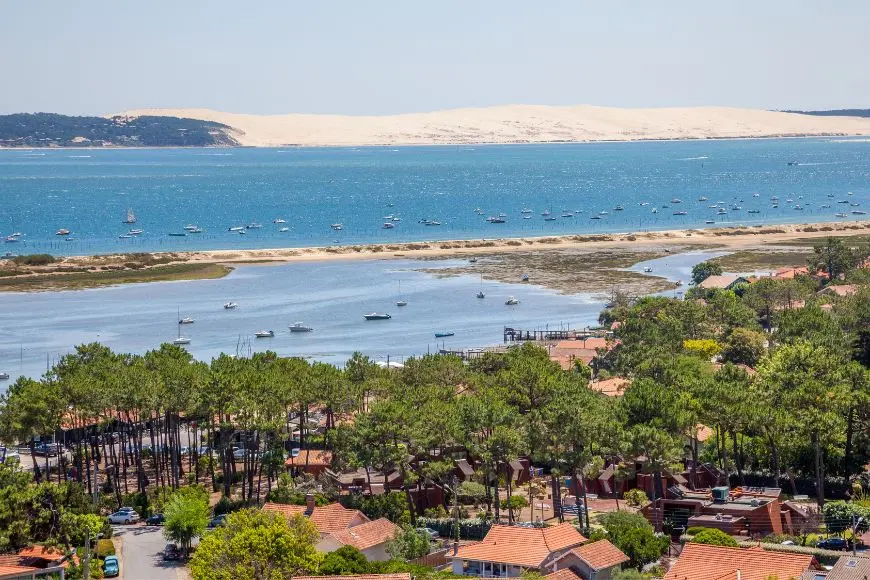
The Arcachon Basin and the Dune du Pilat by train
This is the unmissable excursion, and the most forgiving: with around 25 daily return services, you can leave at 7am or at 2pm.
How to get to Arcachon from Gare Saint-Jean
The TER on line 41 connects Bordeaux Saint-Jean to Arcachon in 50 to 55 minutes, with no change and no reservation required. First departures are around 6am, last returns in the evening around 11pm. Tickets start at a few euros on SNCF Connect if you book in advance.
Our tip: aim for a departure before 8:30am, when the air is still cool and the light rakes across the stilt houses (tchanquees).
Exploring Cap Ferret and Lege-Cap-Ferret by boat
From Arcachon, the best route to Cap Ferret is not the road but the sea. Arcachon boatmen run the crossing from Jetee Thiers to Jetee Belisaire in around 30 minutes, all year round, with evening services in summer. Bikes accepted.
On site, the Cap Ferret lighthouse can be climbed via 258 steps for a view from 57 metres over the Ile aux Oiseaux and the Banc d’Arguin (6 euros adult, 4 euros child). The oyster-farming villages of L’Herbe and Le Canon can then be reached on foot or by bike.
Climbing the Dune du Pilat: practical tips
From Arcachon station, Baia line 3 serves the Dune du Pilat stop in 25 to 30 minutes, every day except Sundays and public holidays. In July and August, the 101 Express line makes the journey in 20 minutes. The ticket costs 2.50 euros single, 4.50 euros return.
- Climb before 10:30am or after 6pm. The sand easily exceeds 50 degrees Celsius in the middle of the day and there is no shade.
- Bring two litres of water per person and sunglasses; the sand reflects a great deal of light.
- Check the fire risk level on gironde.gouv.fr before setting off. On red alert, access to the forest areas may be banned from 2pm to 10pm.
After the Atlantic coast, head to the vineyards and listed villages.
Saint-Emilion: a wine getaway by train
Thirty-five minutes by train to go from the city to a medieval vineyard: this is the best time-to-change-of-scene ratio in the whole Gironde.
Journey from Bordeaux to Saint-Emilion
The TER on line 33, direction Bergerac, stops at Saint-Emilion in 30 to 35 minutes via Libourne. Note the key point for this day out: only 9 to 10 trains run each day, and the last return often departs in the early evening.
Check the time of the last train before ordering a second bottle on the terrace. The station is 1.5 kilometres from the village, a gentle 20-minute uphill walk, with no regular shuttle.
Visiting chateaux and vineyards on foot or by bike
The vineyard begins where the last houses end. Several estates can be reached on foot from Place du Clocher, and the village’s bike hire shops allow you to venture out to the grand cru classe estates on the hillsides. The Grand Saint-Emilionnais tourist office coordinates chateau visits with wine tastings and a small tourist train, very handy when the sun is beating down.
The village listed as a UNESCO World Heritage Site
The jurisdiction of Saint-Emilion has been listed as a World Heritage Site since December 1999, the first vineyard in the world to be distinguished as a cultural landscape: 7,847 hectares and eight communes.
The highlight of the visit remains the monolithic church, carved into the rock from the 12th century onwards, with its 38-metre nave. It can only be visited with a guide; advance booking is strongly advised. Climbing the 196 steps of the bell tower costs 2 euros and offers the finest panoramic view over the vines.
The Landes de Gascogne Regional Nature Park
336,100 hectares, 52 communes, and the largest maritime pine forest in Europe: the contrast with Bordeaux’s waterfront is total.
Getting there by public transport from Bordeaux
Two entry points work very well without a car. Le Teich station, on the Bordeaux-Arcachon line, is 15 minutes on foot from the ornithological reserve. Labouheyre station gives access to the Marqueze Ecomuseum, which can only be reached by the park’s historic train from Sabres. This is the longest outing in this selection: check the last TER return before you go.
Nature walks and discovery of the forest heritage
The Teich ornithological reserve covers 110 hectares and a 6-kilometre loop trail with observation hides. Since 1972, 329 bird species have been recorded there. Allow 3 to 4 hours and around 9.80 euros for adult entry.
Further south, the Leyre river, nicknamed the Little Amazon, can be paddled by canoe: the ideal option on scorching days, in the shade of the forest gallery.
Begles Plage and the Garonne riverbanks by bike
Don’t feel like taking the train? Bordeaux offers its own swimming spot just 20 minutes from the centre.
The V3 bike-sharing scheme
The former V3 is now called Le Velo by TBM: over 2,000 bikes, including a thousand electric ones, spread across 186 stations all equipped with a card reader. The first half-hour is included in the rental, covering most urban journeys.
Cycling routes along the river
The quays extend into a continuous cycle path to the south of the city. From the Pont Saint-Jean, the Roger-Labebie greenway stretches for 47 kilometres of tarmac along a former railway line to Sauveterre-de-Guyenne, with stops at Creon and Espiet.
For swimming, Begles Plage offers a 7-hectare lake, a sandy beach, free entry and supervised bathing from 11am to 7pm in season. The C tram takes you there directly.
Planning your perfect summer day: tips and advice
Booking your train and bus tickets online
Regional TER trains can be taken without a reservation, but the lowest fares are available in advance on SNCF Connect or ter.sncf.com. Baia and Cars Region tickets can be bought on board, at agencies or via the app. Modalis combines all three networks into a single itinerary.
Timetables and frequencies in 2026
Remember this flexibility ranking: Arcachon is the most forgiving with 25 daily return services, Le Teich is very well served, while Saint-Emilion and Labouheyre require planning your return from the morning. Since December 2025, the TBM network has also added the new tram lines E and F, and line C still serves Gare Saint-Jean.
Budget for a car-free excursion
| Day trip | Budget per person |
| Arcachon and Dune du Pilat | 15 to 30 euros |
| Teich Reserve | 22 to 30 euros |
| Saint-Emilion with guided tour | 20 to 35 euros |
| Cap Ferret by boat and lighthouse | 35 to 45 euros |
| Marqueze Ecomuseum | 35 to 45 euros |
The TBM visitor pass (6.50 euros for 24 hours, 17.50 euros for 7 days) covers all your urban journeys, including return trips to the station.
Return to cool comfort – the best is yet to come
The great thing about car-free days is that they end well: you step off the tram and you are already at your destination.
The best moment comes at sunset, when the light falls on the slate rooftops and the city quietens down. That is the time to head up to the Hotel Zoologie rooftop bar, glass in hand, with sand from the Dune still in your shoes.
FAQ
Can you visit several destinations in a single day?
Yes, as long as you stick to the same route. Arcachon, the Dune du Pilat and Cap Ferret combine very well via line 41 and the Baia network. However, combining Saint-Emilion and the Basin on the same day is a race against the timetable: each deserves a day of its own.
What are the best months for these outings?
June and September offer the best compromise: mild temperatures, noticeably lower crowds and well-timed transport. July and August remain the liveliest months, with a real advantage on the coast, where it is generally 2 to 5 degrees cooler than in Bordeaux thanks to the sea breeze.
Are there any advantageous transport passes?
The TBM visitor pass covers city transport from 24 hours to 7 days. The Bordeaux Metropole City Pass adds around ten museums and monuments, the Cite du Vin, the Bassins des Lumieres and a guided tour of your choice (prices to be confirmed at the tourist office, 12 cours du 30 Juillet). For regional coaches, the 10-journey book at 20 euros (10 euros for under-28s) is quickly cost-effective.